

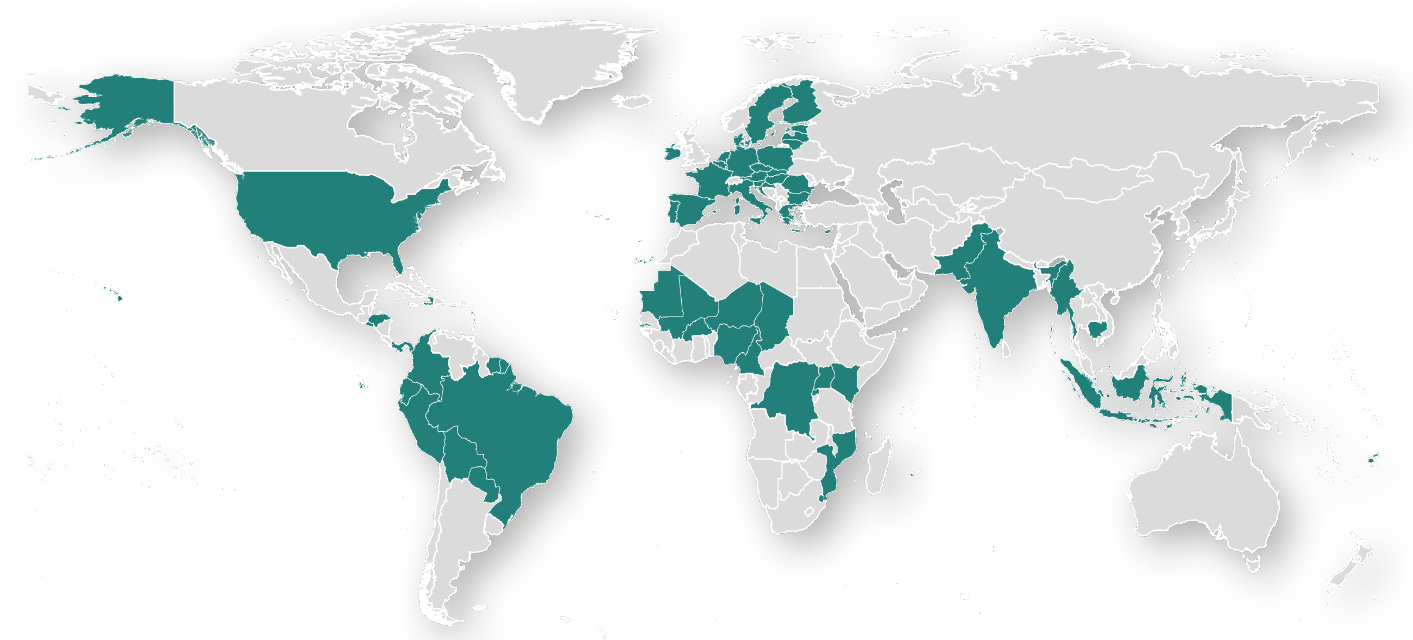
Main audience: institutional clients in 30 countries
AMERICA
Amazon Clean Energy Access Accelerator Initiative (7 countries)
BID · 2024–2025
We supported the IDB Accelerator Initiative through a detailed diagnostic assessment of universal access to energy, light, heat and clean cooking, and the decarbonization of isolated electrical systems in the Amazon region of Colombia, Bolivia, Ecuador, Peru, Brazil, Suriname and Guyana.
PE

Peru — National Plan and Strategies for Universal Electrification (PAUNE)
BID · 2023–2024
We, together with IIT-Comillas, developed Peru's National Geospatial Plan for Universal Electrification, applying the REM© model to identify the lowest-cost solutions—grid expansion, mini-grids, and stand-alone solar systems—in order to achieve universal access by 2030 for approximately 800,000 households without electricity. The work included geospatial modeling, the preliminary technical design of the grid, the development of the business model, tariff design, financing mechanisms, and a GIS visualization and monitoring platform.
PA

Panama — National Plan and Strategies for Universal Electrification (PAUNE)
BID · BID 2023–2024
We, in collaboration with IIT-Comillas, applied the REM© model to determine the location and cost of the technological solutions needed to achieve universal access by 2030, with the goal of serving 170,000 customers without service and making 124,000 additional connections to densify the network. The work included the development of geospatial models, business models and regulations for connected and isolated networks, a financial business plan, and a GIS-based visualization and monitoring tool.
PY

Paraguay — National Plan and Strategies for Universal Electrification (PAUNE)
BID · 2023–2024
We, in collaboration with IIT-Comillas, identified the optimal technological solutions to achieve universal access by 2028, with the goal of reaching 80,000 unconnected residential customers and 380,000 network densification connections, including geospatial analysis, business models, regulatory recommendations, and an investment and financing plan.
SR
Suriname — Development of a rural electrification plan to support the country's efforts to achieve universal access by 2030
BID · 2022–2023
We took charge of the georeferenced plan for universal access to electricity throughout the country, together with TTA, as the coordinating entity, for electrification through mini-grids and universal access in Suriname.
HT

Haiti — National electrification analysis
World Bank · 2022–2023
We, IIT-Comillas, TTA and Castalia carried out the Haiti National Electrification Analysis, in which previous initiatives were reviewed, existing infrastructure was assessed, the national plan combining the electrical grid, mini-grids and autonomous systems was developed, and measures to expand electrification towards 2035 were identified.
PA
Panama — Rural electrification strategy and financial mechanisms
BID · 2023–2024
Beyond the geospatial plan for the lowest cost electrification (PAUNE), this project placed special emphasis on designing the financial mechanisms and regulatory framework needed to mobilize private and public investment for rural electrification—including tariff design, subsidy structures, blended finance instruments, and concession models—in order to enable the sustainable supply of electricity to approximately 170,000 customers without supply and the 124,000 additional grid densification connections needed to achieve universal access by 2030.
BR
Brazil — Support for the implementation of the "More Lights for the Amazon" program
BID · 2022–2023
We have developed the optimal georeferenced plan for universal access to electricity covering remote and isolated communities in Amazonas, Acre, Pará and Roraima, evaluating autonomous solar systems and solar minigrids, including a scenario analysis for telecommunications infrastructure in the Brazilian Amazon.
BO

Bolivia — Integrated National Plan for Rural Electrification (PINERB 2030)
BID · 2021–2022
We and IIT-Comillas developed the PINERB 2030 project in Bolivia using the lowest cost supply optimization through the REM© model, with an individualized technical-economic preliminary project for each client that takes into account the connection to the grid, isolated mini-grids or micro-grids and autonomous solar systems.
SV

El Salvador — Integrated National Electrification Plan
BID · 2021–2022
We led the development of the Integrated National Plan for Grid-Connected and Isolated Electrification of El Salvador for the National Energy Council, creating a geospatial reference database and the lowest cost national electrification plan for the entire country.
CO

Colombia — Integrated National Electrification Plan
MIT Rockefeller Foundation · 2021–2022
We led the MIT Energy Initiative project, in collaboration with IIT-Comillas, to develop Colombia's National Integrated Electrification Plan using REM© for the Ministry of Mines and Energy, identifying the lowest cost options, both on and off the grid, as a strategic basis for systematic expansion and deployment of mini-grids.
CO
Colombia — Integrated Geospatial Plan for Regional Electrification, Pacific and Orinoquía
BID · 2020–2021
We and the UEA Lab developed the Integrated Geospatial Regional Electrification Plan for the Pacific and Orinoquía regions as the first phase of Colombia's national plan, creating a geospatial reference database and the lowest cost plan for both regions.
EC

Ecuador — Integrated National Geospatial Electrification Plan
BID · 2020–2021
We and IIT-Comillas developed Ecuador's National Integrated Geospatial Plan for the Vice Ministry of Electricity, which included lower-cost geospatial models, business models, regulatory recommendations, and an investment and financing plan to achieve universal access by 2030.
CO
Colombia — Electrification Roadmap for the Energy Transformation Mission
BID · 2019–2020
We and IIT-Comillas provided support to Colombia's "Energy Transformation Mission," analyzing electrification expansion policies in both interconnected networks and isolated areas, identifying obstacles to a sustainable and low-cost supply, and proposing the necessary regulatory changes to guarantee universal access.
ON
Peru — Planning of stand-alone solar systems and mini-grids in Loreto
AECID Acciona Microenergy · 2017–2018
The MIT and IIT-Comillas Universal Energy Access Lab, in which the "we" team participates, carried out a technical-economic and business model assessment of the market potential of hybrid mini-grids and stand-alone solar kits in the Peruvian Amazon, thus contributing to the emerging regulatory dialogue to boost the growth of the stand-alone systems sector.
CO
Colombia — Rural electrification planning
Enel Foundation · 2016
As part of a joint research project with the Enel Foundation and in collaboration with MIT and IIT-Comillas, Wayaces carried out rural electrification planning for non-interconnected zones (ZNI) in Colombia. The study assessed the electrification needs of households and agricultural production, analyzed the technical and economic feasibility of expanding the electrical grid, mini-grids, and stand-alone solar systems, and formulated investment and regulatory recommendations to support the expansion of energy access in the country's most remote communities.
AFRICA
Expansion of minigrids: feasibility study for the electrification of two large cities and 120 villages in the Democratic Republic of Congo
International Finance Corporation – IFC – World Bank · 2021–2022
As the first national initiative of IFC’s Scaling Mini-Grid (SMG) program, we developed the feasibility study for the electrification of the cities of Mbuji-Mayi and Kananga and approximately 120 surrounding villages in the Democratic Republic of Congo. Given that only 19% of the population has access to electricity, the program focused on deploying 180 MW of solar photovoltaic capacity—combined with battery storage and smart grids—to connect more than 1.5 million households, businesses, schools, and clinics. Wayaces applied the REM© model to assess the lowest-cost electrification options and local electricity demand, supporting the technical and financial database necessary to structure the £400 million private investment package and the pioneering minimum income guarantee designed to reduce risk and mobilize private capital at scale.
Lake Chad Basin (Nigeria, Niger, Cameroon, Chad) — Access to electricity for displaced populations
World Bank · 2021–2022
We led for TTA the geospatial electrification plan aimed at conducting a comprehensive assessment of access to electricity in conflict-affected communities and displaced populations in the Lake Chad Basin, developing an investment roadmap based on geospatial data with rapid deployment options tailored to dynamic displacement patterns.
Sahel Region (Burkina Faso, Mali, Mauritania, Niger, Chad) — Access to electricity for forcibly displaced populations
World Bank · 2020–2022
We led for TTA the geospatial electrification plan aimed at assessing the needs for access to electricity in five Sahel countries, focusing on conflict zones, border communities and displaced populations, and designed an investment roadmap based on geospatial data with fast and scalable electrification models.
Expansion of mini-grids — Sub-Saharan Africa
International Finance Corporation (IFC) · World Bank · 2019–2020
We contributed to the design of the IFC’s Scaling Mini-Grid (SMG) platform, a World Bank Group initiative aimed at overcoming fragmentation, high transaction costs, perceived risks, and the lack of stable public-private partnership (PPP) frameworks that hinder private capital investment in the mini-grid sector across sub-Saharan Africa. The platform comprises a semi-standardized package of project preparation requirements, PPP model templates, risk mitigation tools, and bundled financing mechanisms, developed by the IFC in close collaboration with the World Bank and MIGA, and based on extensive market consultations with developers, financiers, and governments. Wayaces provided the geospatial electrification planning analysis and technical input that underpinned the platform’s market sizing and country prioritization work, helping to establish the replicable framework that was subsequently deployed in the Democratic Republic of Congo and other African markets.
RW

Rwanda — Integrated Clean Kitchen Plan (Phases I and II)
SE4ALL · 2021–2025
We contributed to the support provided by IIT-Comillas to SEforALL in the development of Rwanda's Integrated Clean Kitchen Plan, creating a state-of-the-art planning framework based on geospatial data for long-term decision-making at the national level in the clean kitchen sector.
Development of the Gambia National Electrification Plan
World Bank · January 2020 – January
We developed The Gambia's universal access strategy and national electrification plan using REM© simulations, producing the technical analysis that underpins the strategic roadmap "Universal Access by 2025 and Transformation of The Gambia's Electricity Subsector." The plan assessed generation options, identified solar sites for land allocation, and developed lower-cost scenarios for grid densification and stand-alone system deployment to guide NAWEC and the World Bank in achieving universal access to electricity in the country.
and

Uganda — Minigrid Planning (Southern Service Territory)
GIZ · 2018–2019
The MIT and IIT-Comillas Universal Energy Access Lab, in which the we team participates, identified optimal locations for minigrids, developed techno-economic designs, and assessed the obstacles to low-cost electrification in southern Uganda, thus contributing to the large-scale deployment of decentralized solutions.
MZ

Mozambique — Assessment of national electrification options
World Bank · 2018–2019
The MIT and IIT-Comillas Universal Energy Access Lab, of which the "we" team is a part, has developed lower-cost electrification scenario models for Mozambique, providing electric utility-level advice and training to EDMs and national authorities as an analytical basis for the national electrification strategy.
RW
Rwanda — National Electrification Plan 2024
World Bank EDCL · 2018–2019
The MIT and IIT-Comillas Universal Energy Access Lab, of which the "we" team is a part, has developed lower-cost electrification scenario models for Mozambique, providing electric utility-level advice and training to EDMs and national authorities as an analytical basis for the national electrification strategy.
RW
Rwanda — Karambi Community Solar Microgrid (pilot project driven by a school)
Iberdrola · 2014–2016
The UEA Lab led the design of a pilot solar microgrid in Karambi using the rural school as the main load, defining a sustainable business model and replicable regulatory framework, along with a strategy to scale up to thousands of schools across Rwanda.
KE

Kenya — Minigrid Assessment
Enel Foundation · 2016
Within the framework of a joint research project with the Enel Foundation and in collaboration with MIT and IIT-Comillas, the UEA Lab conducted a comprehensive assessment of minigrid deployment opportunities in Kenya. The project identified sites with high potential for the development of solar minigrids, evaluated the technical and economic feasibility of different electrification methods, and formulated regulatory and business model recommendations to facilitate private sector participation in Kenya's off-grid market.
KE
Kenya — Rural electrification planning
Enel Foundation · 2016
The UEA Lab applied the REM© model to a comprehensive computer-aided planning approach for universal energy access in Kilifi County, Kenya, resulting in a building-scale geospatial electrification plan for rural Kilifi. The study determined the most cost-effective combination of grid expansion, mini-grids, and stand-alone systems, and developed investment and business model recommendations to contribute to Kenya's national electrification strategy.
ASIA
PK

Pakistan — Study on lowest cost electrification and assessment of the minigrid portfolio
World Bank · 2021–2023
We and IIT-Comillas led the geospatial and regulatory analysis components of the Pakistan Least Cost Electrification Study, using REM© and VIDA to model optimal power grid systems, mini-grids and stand-alone systems for 32 million households, resulting in policy recommendations, intermediate milestones and investment frameworks.
ID

Indonesia — Roadmap for decarbonization · Moluccas and Papua
Asian Development Bank · 2018–2020
As part of the universal access plan for Maluku and Papua, the Wayaces team designed a decarbonization roadmap for the Asian Development Bank (ADB), identifying the lowest-cost ways to replace the diesel systems of more than 200 remote communities with hybrid renewable solutions, combining solar photovoltaic power and battery storage. The work included a feasibility analysis, technology selection, investment sequencing, and policy recommendations for the Indonesian National Land Agency (PNL) and the Indonesian government to wean the isolated islands' electricity grids off fossil fuels.
KH

Development of off-grid electrification planning in Cambodia
Palladium Group / Australian DFAT · 2019
Wayaces developed a minimum-cost plan for minigrids and other off-grid solutions in Cambodia as part of the 3i (Investing in Infrastructure) program, implemented by Palladium and funded by the Australian Government through DFAT. The REM© model was applied to design autonomous systems for remote and mountainous regions where extending the electricity grid was not feasible, providing a geospatial baseline and investment portfolio to support the Royal Government of Cambodia in delivering affordable, clean electricity to off-grid communities.
ID
Indonesia — Electrification plans for the Moluccas and Papua
BAD · 2018–2020
The UEA Lab team developed the universal access plan for Moluccas and Papua, providing advice to PLN and the Government on the integration of grid-connected and stand-alone systems.
IN

India — Minigrid planning for Uttar Pradesh and Bihar
Rockefeller Foundation Tata Power · 2018–2019
The UEA Lab provided optimal locations, a geospatial plan, regulatory advice and the design of a business model for the large-scale deployment of minigrids in Uttar Pradesh and Bihar, collaborating with the Central Electricity Regulatory Commission on regulatory reforms.
IN
India — Development of a regulatory framework for minigrids
Rockefeller Foundation Tata Power · 2019
The UEA Lab team identified potential microgrid sites that could be connected to existing electricity grid infrastructure for Tata Power DDL and the Rockefeller Foundation, and developed regulatory guidelines and business model frameworks to support the deployment of solar microgrids in India’s poorest rural states. This work informed the design of replicable, grid-compatible microgrid models and contributed to the regulatory dialogue with India’s Central Electricity Regulatory Commission, enabling large-scale deployment by the private sector.
IN
India — Planning for rural electrification and universal access – State of Bihar
Rockefeller Foundation Tata Power · 2019
The UEA Lab team applied the Electrification Reference Model (REM©) to determine the lowest-cost electrification solution for approximately 400,000 buildings without electricity in Bihar, India, assigning each building either a stand-alone system, a minigrid, or an extension of the existing grid. The project identified electrified and partially electrified villages using satellite imagery and data analysis, developing a statewide electrification plan to support the large-scale deployment of minigrids in Bihar and Uttar Pradesh.
OTHERS
The integrated energy company of the future for electrification in developing countries
Shell Foundation · January 2018 – December 2018
Wayaces, in collaboration with the MIT-Comillas Universal Energy Access Lab, conducted a comprehensive global assessment in 54 countries to identify challenges and opportunities for accelerating universal energy access through integrated grid strategies and stand-alone systems. The study analyzed financial, regulatory, social, environmental, and technological barriers and developed a replicable business model that combines grid expansion, mini-grids, stand-alone systems, and grid-connected smart grids with distributed generation. As a direct result, the Shell Foundation created Konexa in Kano, Nigeria—an integrated energy company that implements the recommended model in a defined service territory, agreed upon with the government and the regional utility—serving as a pilot project for future initiatives across the country.
IS

Challenges of universal access to modern energy and its impact on climate change: models to support decision-making
Ministry of Economy and Competitiveness (Spain) · January 2015 – March 2018
A national R&D project funded by the Spanish Ministry of Economy and Competitiveness, dedicated to developing integrated decision-support models to assess the barriers to universal access to modern energy services and their relationship to climate change. The project combined geospatial planning, techno-economic modeling, and policy analysis to develop evidence-based frameworks for policymakers and development institutions seeking to accelerate access to clean and affordable energy while meeting climate commitments.
PUBLICATIONS AND MEDIA APPEARANCES
Articles from scientific journals
[1]
Ciller, P.; Lumbreras, S.; González-García, A. (2026).
Which customers belong together? An enhanced off-grid clustering algorithm for cost-effective rural electrification.
Energy Strategy Reviews, 65, 102213. https://doi.org/10.1016/j.esr.2026.102213
[2]
González-García, A.; Díaz-Pastor, S.J.; Moreno-Romero, A. (2023).
A Comprehensive Approach to the Governance of Universal Access to Sustainable Energy Services.
Sustainability, 15(22), 15813. https://doi.org/10.3390/su152215813
[3]
González-García, A.; Ciller, P.; Lee, S.J.; Palacios, R.; de Cuadra, F.; Pérez-Arriaga, I.J. (2022).
A Rising Role for Decentralised Solar Minigrids in Integrated Rural Electrification Planning? Large-Scale, Least-Cost, and Customer-Wise Design of Grid and Off-Grid Supply Systems in Uganda.
Energies, 15(13), 4517. https://doi.org/10.3390/en15134517
[4]
Ciller, P.; Lumbreras, S.; González-García, A. (2021).
Network Cost Estimation for Mini-Grids in Large-Scale Rural Electrification Planning.
Energies, 14(21), 7382. https://doi.org/10.3390/en14217382
[5] Sánchez-Jacob, E.; González-García, A.; Mazorra, J.; Ciller, P.; Lumbreras, J.; Pérez-Arriaga, J.I. (2021). Joint Optimal Planning of Electricity and Modern Energy Cooking Services Access in Nyagatare. Energies, 14(14), 4198. https://doi.org/10.3390/en14144198
[6]
Ciller, P.; Lumbreras, S. (2020).
Electricity for All: The Contribution of Large-Scale Planning Tools to the Energy-Access Problem.
Renewable and Sustainable Energy Reviews, 120, 109624. https://doi.org/10.1016/j.rser.2019.109624
[7]
Ciller, P.; de Cuadra, F.; Lumbreras, S. (2019).
Optimizing Off-Grid Generation in Large-Scale Electrification-Planning Problems: A Direct-Search Approach.
Energies, 12(24), 4634. https://doi.org/10.3390/en12244634
[8] Ciller, P.; Ellman, D.; Vergara, C.; González-García, A.; Lee, S. J.; Drouin, C.; Brusnahan, M.; Borofsky, Y.; Mateo, C.; Amatya, R.; Palacios, R.; Stoner, R.; de Cuadra, F.; Pérez-Arriaga, I. J. (2019). Optimal Electrification Planning Incorporating On- and Off-Grid Technologies: The Reference Electrification Model (REM). Proceedings of the IEEE, 107(9), 1395–1418 [JIF 25.9 Q1]. https://doi.org/10.1109/JPROC.2019.2960480
[9]
Pérez-Arriaga, I.J.; Stoner, R.; González-García, A.; Amatya, R.; Rahnama, R.; Lee, S.J.; Jacquot, G.; Protzer, E.; Brusnahan, M.; Dueñas, P. (2019).
A Utility Approach to Accelerate Universal Electricity Access in Less Developed Countries: A Regulatory Proposal.
Economics of Energy and Environmental Policy, 8(2). https://doi.org/10.5547/2160-5890.8.2.iper
[10]
González-García, A.; Amatya, R.; Stoner, R.J.; Pérez-Arriaga, I.J. (2016).
Evaluation of Universal Access to Modern Energy Services in Peru. Case Study of Scenarios for Electricity Access in Cajamarca.
Enel Foundation Working Papers.
Working papers, reports and technical notes — Authors from Wayaces and the UEA Lab
[11]
Pérez-Arriaga, I.J.; Díaz-Pastor, S.; Mastropietro, P.; de Abajo, C. (2022).
The Electricity Access Index: Methodology and Preliminary Findings.
Global Commission to End Energy Poverty Working Paper.
[12]
de Abajo, C.; Díaz-Pastor, S.J.; González-García, A.; Pérez-Arriaga, I.J. (2021).
A Business Plan to Achieve Full Electrification in Rwanda Under the Integrated Distribution Framework (IDF).
Global Commission to End Energy Poverty Working Paper.
[13]
Pérez-Arriaga, I.J.; Stoner, R.; Nagpal, D.; Jacquot, G. (2021).
Harnessing the Power of Integration to Achieve Universal Electricity Access: The Case for the Integrated Distribution Framework.
Handbook on Electricity Markets, Edward Elgar.
[14]
Pérez-Arriaga, I.J.; Nagpal, D.; Jacquot, G.; Stoner, R. (2020).
Integrated Distribution Framework: Guiding Principles for Universal Electricity Access.
Global Commission to End Energy Poverty Working Paper.
[15]
Pérez-Arriaga, I.J.; Stoner, R.; Nagpal, D.; Jacquot, G. (2020).
2020 Report — Electricity Access.
The Global Commission to End Energy Poverty.
[16]
Lee, S.J.; Stoner, R.; Pérez-Arriaga, I.J. (2020).
The Integrated Distribution Framework and the Global Commission to End Energy Poverty: Exploring Pathways for Accelerating Universal Access to Modern Energy Services.
Working Memo.
[17] Lee, SJ; Sanchez-Jacob, E.; González-García, A.; Ziller, P.; Dueñas-Martínez, P.; Taneja, J.; de Cuadra, F.; Lumbreras, J.; Daly, H.; Stoner, R.; Pérez-Arriaga, IJ (2019). Investigating the Necessity of Demand Characterization and Stimulation for Geospatial Electrification Planning in Developing Countries. MIT CEEPR Working Paper 2019-017. https://ceepr.mit.edu/?p=5052
[18]
Pérez-Arriaga, I.J.; Jacquot, G.; Stoner, R.; Nagpal, D. (2019).
Assessing the Potential of Electrification Concessions for Universal Energy Access: Towards Integrated Distribution Frameworks.
Global Commission to End Energy Poverty Working Paper.
[19]
Pérez-Arriaga, I.J.; Stoner, R.; Nagpal, D.; Jacquot, G. (2019).
Global Commission to End Energy Poverty: Inception Report.
MIT Energy Initiative.
[20]
MIT–Comillas Universal Energy Access Laboratory (2018).
Computer-Aided Electrification Planning in Developing Countries: The Reference Electrification Model (REM).
IIT Working Paper IIT-18-010A / Comillas Repository. https://repositorio.comillas.edu/xmlui/handle/11531/35309
[21]
Amatya, R.; González-García, A.; Stoner, R.J.; Pérez-Arriaga, I.J. (2014).
Low-Cost Energy Technologies for Universal Access: Electricity.
Enel Foundation Working Papers.
[22]
Amatya, R.; González-García, A.; Stoner, R.J.; Pérez-Arriaga, I.J. (2014).
Low-Cost Energy Technologies for Universal Access: Modern Heat.
Enel Foundation Working Papers.
[23]
González-García, A.; Amatya, R.; Stoner, R.J.; Pérez-Arriaga, I.J. (2014).
Appropriate Technologies, Business Models and Enabling Environment for Universal Access to Modern Energy Services.
Enel Foundation Working Papers.
Media appearances — selection
▸ Power to the People — MIT News — MIT Energy News (2023) https://energy.mit.edu/news/power-to-the-people/
▸ 'The Adventure of Knowledge' — Andrés González-García — RTVE La 2 (Spain) (2021) https://www.rtve.es/alacarta/videos/la-aventura-del-saber/aventura-del-saber-andres-gonzalez/4929678/
▸ 'The Adventure of Knowledge' — Ignacio Pérez-Arriaga (MIT) — RTVE La 2 (Spain) (2021) https://www.rtve.es/alacarta/videos/la-aventura-del-saber/aventura-mit-jose-ignacio-perez-arriaga/4826027/
▸ Engineering with Purpose Award 2024 — ICAI College of Engineers Foundation (2024) https://www.youtube.com/watch?v=_yBcDZFyZJE&t=598s
▸ The impact of engineers on people's lives. ICAI – Interview with Fernando de Cuadra – Andrés González-García — ICAI Talent (2025)
https://www.icai.es/andres-gonzalez-y-fernando-de-cuadra/
▸ The AI Revolution and the Future of Electrification — Asian Development Bank Innovation Speakers' Series (2019)
▸ The Virtuous Cycle of Clean Cooking and Electricity Costs — Energy for Growth Hub (2019)
▸ Empowered Planning with Models, Satellites, and Machine Learning — Energy for Growth Hub (2018)
Request the investment dossier
Qualified investors can access the pitch deck, business model, financial projections, and capitalization table after a brief introductory contact.